

Most product teams jump from gut feeling straight into development. A hypothesis statement is what sits between the two. It's a structured, testable prediction that turns "we think this might work" into something you can actually measure.
For UX designers racing against sprint deadlines, CX managers defending budget decisions, and product leaders navigating stakeholder expectations, hypothesis-driven development is a must-have today.
Traditional research cycles that take weeks or months create bottlenecks that agile teams can't afford. You need a way to validate concepts quickly, fail fast when ideas don't resonate, and build confidence in your direction before committing serious resources.
This article walks you through a framework for creating hypothesis statements that actually work in real environments. You'll learn:
- The exact components every hypothesis needs
- Step-by-step process you can apply immediately
- How modern validation platforms compress feedback loops from weeks into days
Key takeaways
- A hypothesis statement is a testable prediction that links specific variables to measurable outcomes, not a guess or assumption
- Effective hypotheses require three non-negotiable elements: a clear independent variable (what you change), a dependent variable (what you measure), and a defined user segment (who you're studying)
- The "If...Then" framework provides the simplest and most actionable structure for creating hypotheses that teams can immediately test
- Continuous validation platforms enable hypothesis testing in days instead of weeks, allowing multiple experiments per sprint cycle
- Data-driven hypotheses eliminate decisions made on gut feel and align cross-functional teams around shared evidence, preventing wasted development effort on features that don't resonate
What is a hypothesis statement in service and product development?
A hypothesis statement is a tentative, testable answer to a specific research question about your product or user experience. Understanding what a hypothesis is at a foundational level helps teams avoid conflating it with assumptions or conclusions.
Think of it as your best educated prediction about what will happen when you make a change, grounded in data you already have rather than wishful thinking. The keyword here is testable. If you can't design an experiment to prove or disprove your statement, it's not a hypothesis.
Two characteristics make a hypothesis professional-grade rather than just another product idea. First, it must be testable through observable methods like A/B testing, user observations, or analytics tracking.
Second, it must be falsifiable, meaning it's structured so that evidence could potentially prove it wrong. This prevents confirmation bias and forces you to accept what the data actually shows.
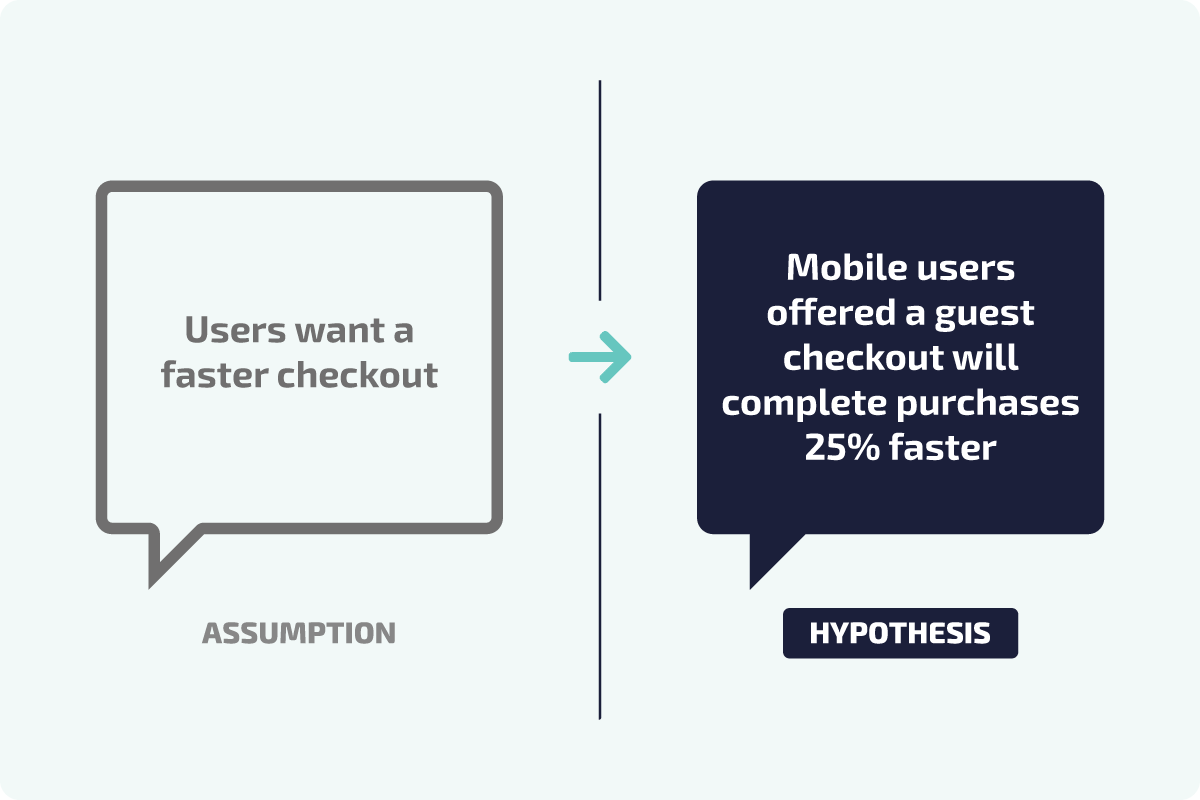
A thesis statement summarises a conclusion you've already reached after analysing evidence (like in a research paper). A product assumption is often a belief that hasn't been validated yet. A hypothesis sits between these. For example, "Users want faster checkout" is an assumption. "Mobile users who are offered guest checkout will complete purchases 25% faster than those required to create accounts" is a hypothesis.
"Users want faster checkout" is a perfectly reasonable starting point.
"Users want faster checkout" is a perfectly reasonable starting point. Most product teams begin there, with a gut feeling, a complaint from sales, or a pattern in the data. The question isn't whether that assumption is valid. It's how you test it efficiently.
A hypothesis turns that assumption into something testable: "Mobile users offered guest checkout will complete purchases 25% faster than those required to create an account." Same insight, but now you know what to measure, who to observe, and what success looks like.
The observations that lead there, cart abandonment at the account creation step, hesitation when shipping costs appear late, are already in your data. A hypothesis just makes them actionable.
Start with what you already know
Strong hypotheses are always grounded in existing data, user patterns, and preliminary research. You might notice in your analytics that mobile users abandon carts at the account creation step. You might see in session recordings that users hesitate when shipping costs appear late in the process. These observations become the foundation for your hypothesis, not random guesses about what might work.
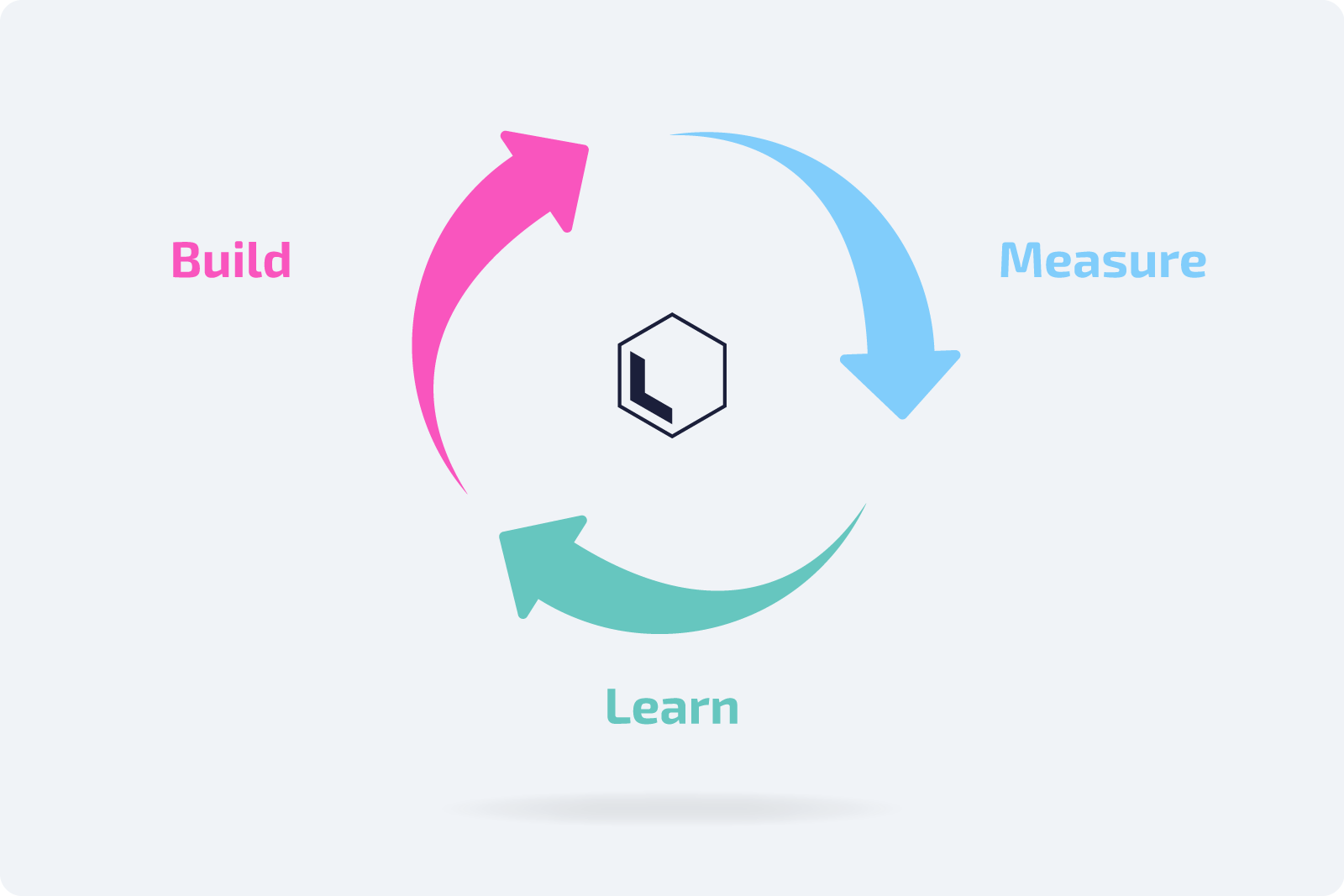
In agile environments, the hypothesis serves as the foundation of the "Build-Measure-Learn" loop. You build a minimal version of your idea, measure whether your hypothesis holds true, and learn from the results to inform your next move. Without a clear hypothesis, you're just building features and hoping they work—there's no structured way to know if you're making progress or just creating noise.
"A hypothesis is not just an educated guess. It's a structured prediction that turns product development from an art into a science."
Clarity and specificity matter because vague predictions can't be validated. "Users will like the new design" tells you nothing actionable. What does "like" mean? Which users? What aspect of the design? How will you measure it?
A proper hypothesis removes all that ambiguity: "First-time visitors aged 25-40 will spend 30% more time exploring product pages when we add customer review videos to the top of each page." Now you know exactly what to build, who to watch, and what to measure.
Core components every hypothesis must include
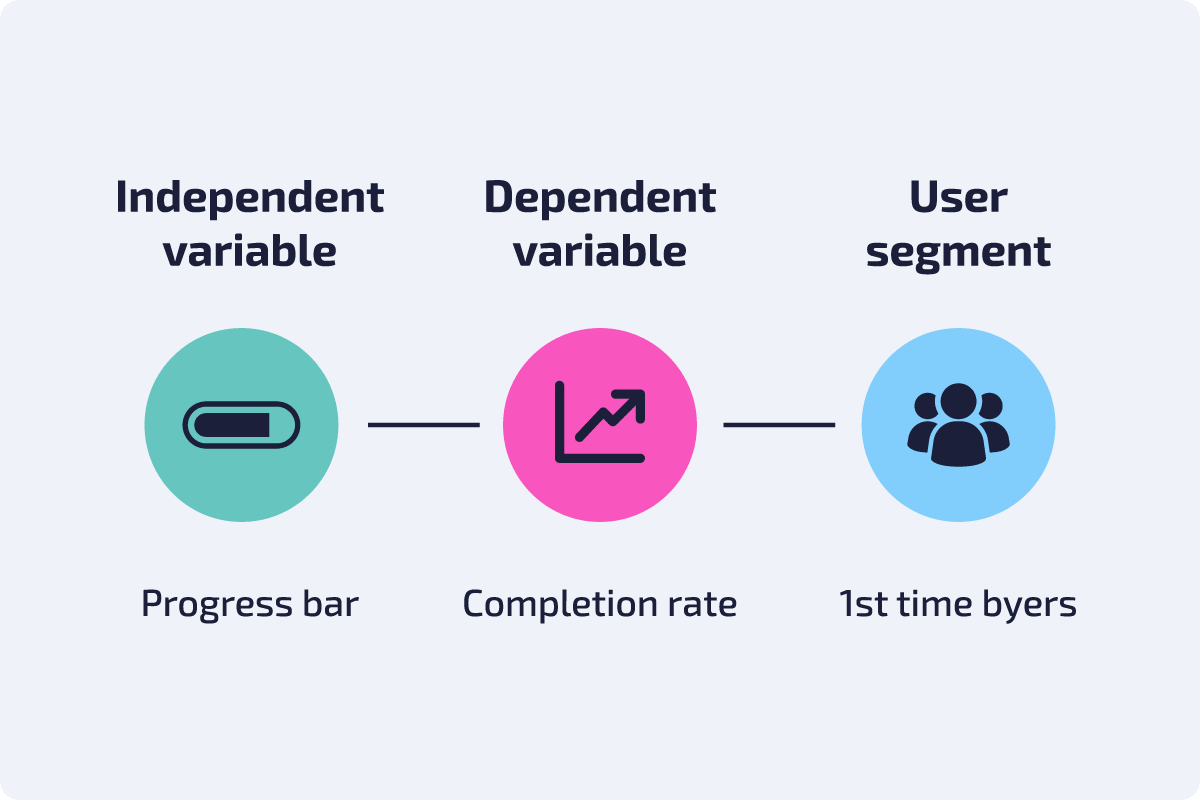
Every testable hypothesis is built from three essential components that work together to create a clear, measurable prediction. Miss any one of these, and your hypothesis becomes too vague to validate effectively.
Independent variable
The independent variable is the element you control or change in your experiment. In product development, this might be a new feature you're adding, a UI element you're modifying, or a messaging variation you're testing. For example, if you're testing whether a progress bar improves form completion, the progress bar is your independent variable. It's the "cause" in your cause-and-effect prediction. The critical point here is that you must be able to control this variable—you can turn it on or off, show it to some users and not others, or compare different versions of it.
Dependent variable
The dependent variable is the measurable outcome you observe to see how it reacts to your independent variable. This is the "effect" you're predicting. Common dependent variables in product work include:
- Conversion rates
- Task completion time
- Error rates
- Satisfaction scores
- Feature adoption rates
Using our progress bar example, the dependent variable might be "form completion rate" or "time spent on the form." The dependent variable must be something you can measure objectively—not subjective impressions like "users seemed happier."
Specific user segment
The specific user segment defines exactly who you're studying. This is where many hypotheses fall apart. Saying "users" is too broad. Are you talking about first-time visitors or returning customers? Mobile users or desktop users? People in a specific age range or geographic location? The more precisely you define your segment, the more actionable your insights become. "Mobile shoppers aged 25-40 making their first purchase" gives you a much clearer testing target than just "shoppers."
You also need to account for control variables, external factors that might influence your results. These are elements you want to keep constant during testing so you can be confident that changes in your dependent variable are actually caused by your independent variable, not by something else. If you're testing a new checkout flow, you'd want to control for factors like time of day, traffic source, or promotional campaigns that might skew results.
Here's a simple formula that brings it all together:
"For [specific user group], if we [independent variable], then [dependent variable] will [predicted change]."
Let's see how this works in practice with some real business challenges:
|
Business Challenge |
Independent Variable |
Dependent Variable |
Specific Group |
|
Low newsletter signups |
Signup box position |
Total signups |
Blog readers |
|
High cart abandonment |
Guest checkout option |
Abandonment rate |
Mobile shoppers |
|
Slow onboarding |
30-second tutorial video |
Time to first action |
New users |
Notice how each example clearly identifies what's being changed, what's being measured, and who's being studied. This structure makes it immediately obvious how to set up your test and what success looks like.
When you're building your own hypotheses, use this table format as a quick check. If you can't clearly fill in all three columns, your hypothesis needs more work.
Step-by-step framework for developing testable hypotheses
Creating a strong hypothesis is a systematic process that moves from broad questions to precise, actionable statements. Here's the framework that works consistently across product teams.
Step 1: Start with a focused research question
Move from general concerns to specific inquiries. Instead of asking "Why aren't users converting?", narrow it down to "Why are mobile users abandoning their carts at the payment screen?"
The more focused your question, the more targeted your hypothesis can be. Look at your analytics, support tickets, or user feedback to identify the specific friction point you want to address. A good research question points to a particular user behavior, a specific part of the user journey, and a measurable outcome.
Step 2: Conduct preliminary research
Before you write your hypothesis, gather evidence. Review your existing analytics to spot patterns. Watch session recordings to see where users hesitate or drop off. Read through customer feedback or support tickets for recurring complaints. Check heatmaps to understand where attention goes.
This preliminary research serves two purposes: it prevents you from testing something that's already been proven or disproven, and it gives you a data foundation so your hypothesis isn't just a guess. You're looking for patterns that suggest a cause-and-effect relationship you can test.
Step 3: Formulate your initial prediction
Based on what you found in your research, write a simple sentence expressing what you expect to find. At this stage, don't worry about perfect phrasing—just get the core idea down. For example: "Adding trust badges will make people more comfortable checking out." This rough draft captures your thinking and gives you something to refine.
Step 4: Refine for specificity and measurability
Now take your rough prediction and make it precise. Replace vague terms like "improve," "better," or "more comfortable" with quantifiable metrics. Instead of "make people more comfortable," use "reduce cart abandonment by 15%" or "increase checkout completion rate to 75%." Define your user segment clearly. Specify the exact change you're making. The refined version might read: "For mobile users making their first purchase, displaying security badges above the payment form will reduce cart abandonment by 15% compared to the current checkout flow."
Step 5: Structure using proven formats
Different situations call for different hypothesis formats. Choose the one that fits your testing context:
If...Then format: This is the most straightforward structure for product experiments. "If we provide a progress bar during the checkout process, then form completion rates will increase by 20%." It clearly shows the change you're making and the outcome you expect.
Correlation format: Use this when you're exploring relationships between variables rather than testing a specific intervention. "There is a positive correlation between onboarding video views and feature adoption rates within the first week." This format works well for discovery research where you're trying to understand patterns.
Comparison format: This structure is perfect for A/B tests where you're comparing two versions. "Users who see social proof testimonials will convert at higher rates than those who see product specifications alone." It explicitly sets up the comparison you're making.
The critical element across all formats is falsifiability—structure your hypothesis so evidence can prove it wrong. This isn't a flaw; it's what makes your hypothesis scientific. If you write "Adding a feature will make the product better," there's no way to disprove it because "better" is subjective. But if you write "Adding one-click reordering will increase repeat purchase rates by 20% within 30 days," you've created a clear pass/fail criterion.
Avoid these common pitfalls:
- Don't make your hypothesis too broad (testing multiple changes at once makes it impossible to know what caused the result)
- Don't include multiple variables (if you change both the button color and the copy, which one drove the outcome?)
- Don't make predictions that can't be measured (how do you quantify "users will be happier"?)
Each hypothesis should test one clear relationship between variables.
How to validate hypotheses rapidly with continuous customer collaboration
Here's the challenge that keeps product teams stuck: Traditional research methods take weeks or months to deliver insights. You need to recruit participants, schedule sessions, conduct interviews, analyze results, and compile reports. By the time you have answers, your sprint is over, and stakeholders are asking why development hasn't started.
This timeline mismatch between agile development cycles and traditional research creates a bottleneck that forces teams to either skip validation entirely or slow down their release cadence.
Continuous customer collaboration platforms solve this by transforming hypothesis validation from a slow, resource-intensive project into an agile, ongoing practice. Instead of treating user research as a separate phase that happens before or after development, you integrate it directly into your sprint workflow.
This means you can test hypotheses in days or even hours instead of weeks, enabling true "Build-Measure-Learn" loops that fit within your existing development rhythm.
Leanlab's approach centers on creating a private customer lab. It’s an always-on environment where you maintain direct engagement with your specific customer base. Rather than recruiting new participants for every study, you build a community of your actual users who are ready to provide feedback whenever you need it. This eliminates the recruitment bottleneck that typically adds weeks to research timelines.
Understand the "why" before you hypothesize
The platform provides multiple tools designed for different stages of hypothesis validation:
Ideation tools help you understand the "why" behind user behaviors before you even formulate your hypothesis:
- Self-reporting diaries capture long-term behavior patterns in real-world contexts, revealing pain points and habits that single interviews miss
- Discussion forums let you dive deeper into user motivations and preferences
- Surveys and polls provide quantified alignment on specific questions, helping you gauge sentiment at scale
These tools make sure your hypotheses are grounded in actual user needs rather than internal assumptions.
Validate your hypothesis
Rapid testing tools accelerate the validation phase once you've formed your hypothesis:
- Sorting and preference tests help you prioritize ideas by showing which concepts customers value most
- First-click tests provide quick feedback on whether users can find what they need in your design
- Unmoderated usability tests let you run large-scale evaluations on prototypes or existing services without scheduling dozens of individual sessions
- Visual and messaging tests enable you to compare different design directions, concepts, or offers and gather real-time feedback in hours
Guidance by AI for designing the right research
Leanlab's AI Research Advisor acts as a built-in consultant that helps you frame the right problems and design targeted research. Instead of guessing which questions to ask or how to structure your test, you get guidance on creating research activities that will actually answer your hypothesis.
Consider what this looks like in practice. Lindex, a fashion retailer, reduced their feedback cycles from weeks to just 24 hours using Leanlab. Their UX designer, Niknaz Moslehi, explained that they can now create research activities and receive answers the same day or next day, transforming user research from a bottleneck into a smooth, cost-saving process.
This speed allowed them to run tests they would otherwise have skipped due to time constraints—tests that revealed how challenging it is to predict users' thoughts without direct feedback.
"We can create research activities and receive answers the same day or next day. User research has transformed from a bottleneck into a smooth, cost-saving process." — Niknaz Moslehi, UX Designer at Lindex
This rapid validation capability changes how you approach hypothesis testing. Instead of carefully selecting one or two hypotheses per quarter to test through expensive research, you can test multiple hypotheses per sprint.
You can validate early concepts before investing in full development. You can catch weak ideas before they consume engineering resources. You can compare multiple approaches quickly to find the strongest direction.
From gut feeling to shared evidence
The shift from subjective "gut feelings" to clear, quantified customer data also transforms stakeholder conversations.
When you present a hypothesis backed by data from your actual customer base, you build confidence that's impossible to achieve with internal opinions alone.
LocalTapiola's Head of CX Renewal and Design Tools, Jenni Reijonen, noted that direct customer access through Leanlab enabled over 100 mini-research projects and fostered a fundamental shift from a "we know best" mentality to a true customer-first approach.
Continuous validation prevents the most expensive mistake in product development: building features that don't resonate with users. Every hypothesis you validate before development saves you from wasted engineering time, reduces the risk of launching features that hurt rather than help, and accelerates your path to product-market fit.